📖 Weekly Progress - Paper Reading & Survey
Paper #1: MalImgDA
MalImgDA: Diffusion-based Data Augmentation for Long-tailed Malware Family Classification
Gang Yang; Jun He; Bo Wu; Tao Xia; Linna Fan; Lin Ni 2025 IEEE International Conference on Acoustics, Speech, and Signal Processing (ICASSP), Published 2025/03
Problem:
- Imbalanced or long-tailed distribution among various malware families.
- Difficulty in classifying few-shot malware families, which reduces classifier effectiveness.
Proposed Solution: MalImgDA
Results:
- Experiments on two publicly available datasets demonstrate the effectiveness of MalImgDA.
- Outperforms other commonly-used methods in malware classification.
Methodology
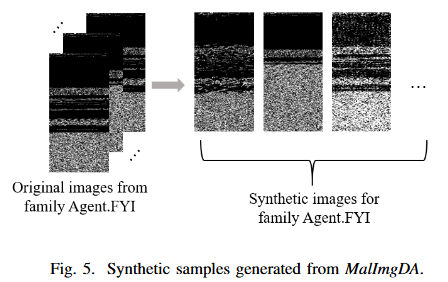
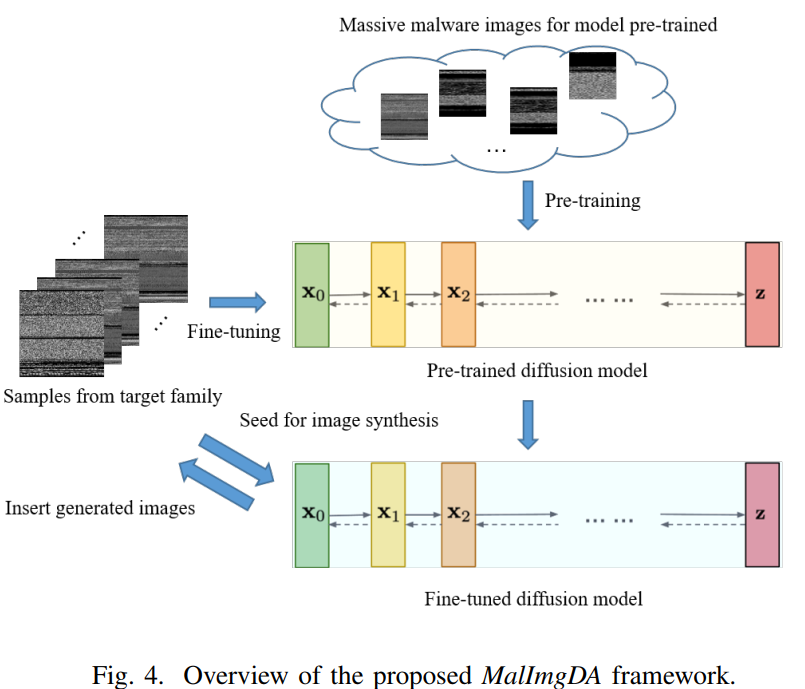
- Diffusion Model Pre-training and Fine-tuning
- Diffusion Model-based Malware Image Generation
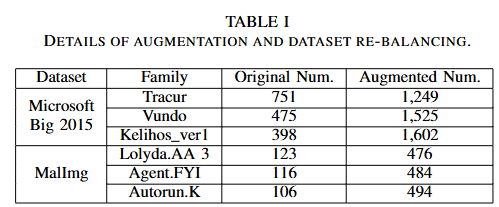
- Dataset Re-balancing for Image Model Training
Paper #2: ADAF
Towards Prompt-robust Face Privacy Protection via Adversarial Decoupling Augmentation Framework
Ruijia Wu, Yuhang Wang, Huafeng Shi, Zhipeng Yu, Yichao Wu, Ding Liang ArXiv:2305.03980 [cs.CV], Published 2023/05
Problem:
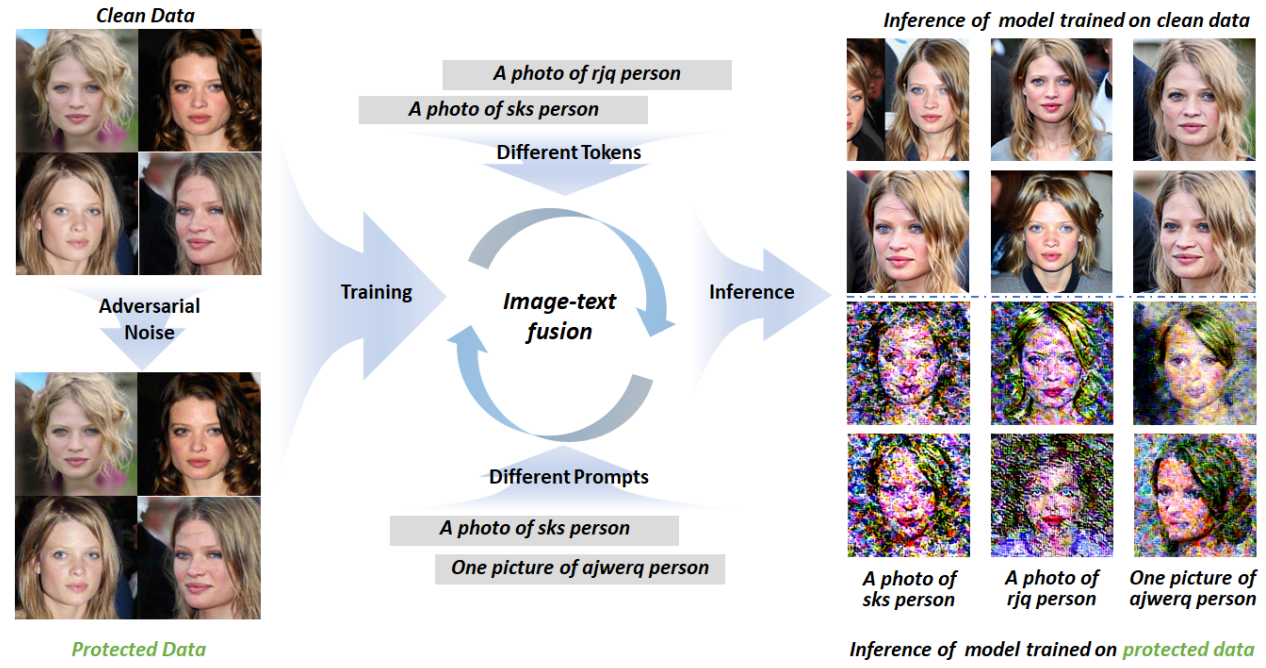
- The image-text fusion module is a vital component of text-to-image diffusion models, responsible for combining textual information with the image generation process.
- Current privacy protection methods neglect this crucial fusion module, leading to unstable defense performance against different attacker prompts.
Proposed Solution: Adversarial Decoupling Augmentation Framework (ADAF)
Results:
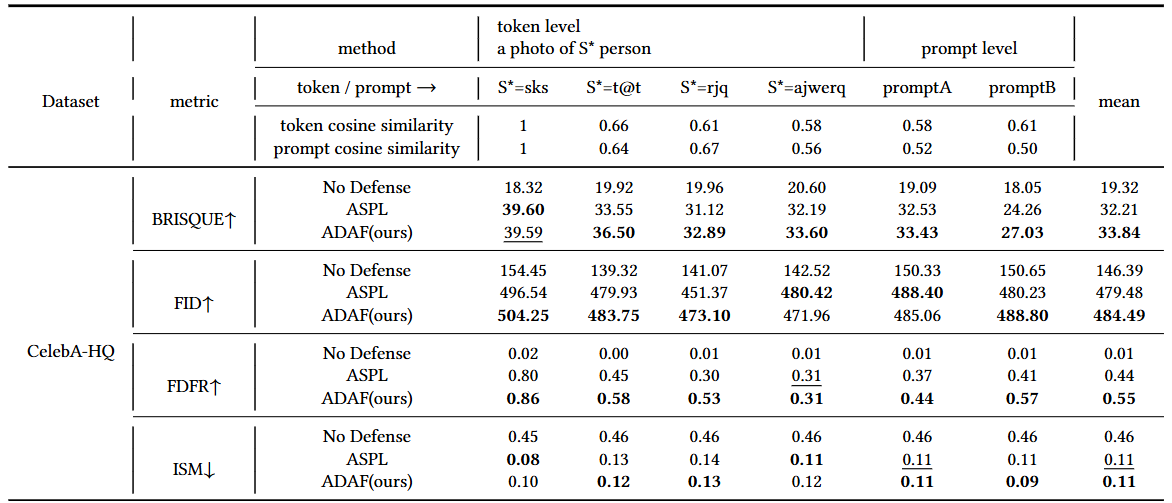
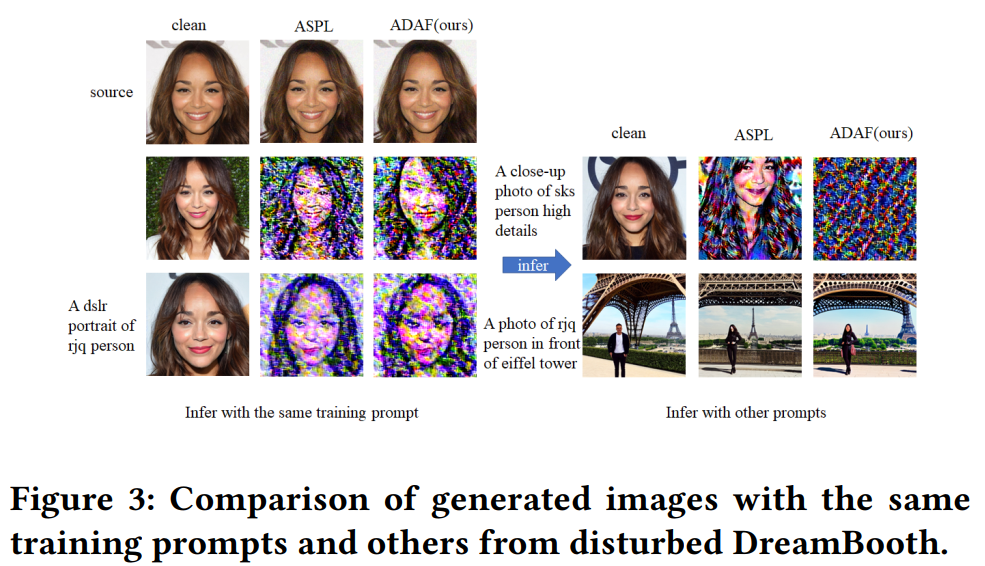
- ADAF outperforms existing algorithms, demonstrating promising performance in enhancing facial privacy protection in text-to-image models.
Abstract
Text-to-image diffusion models methods are unstable against different attacker prompts.
Methodology
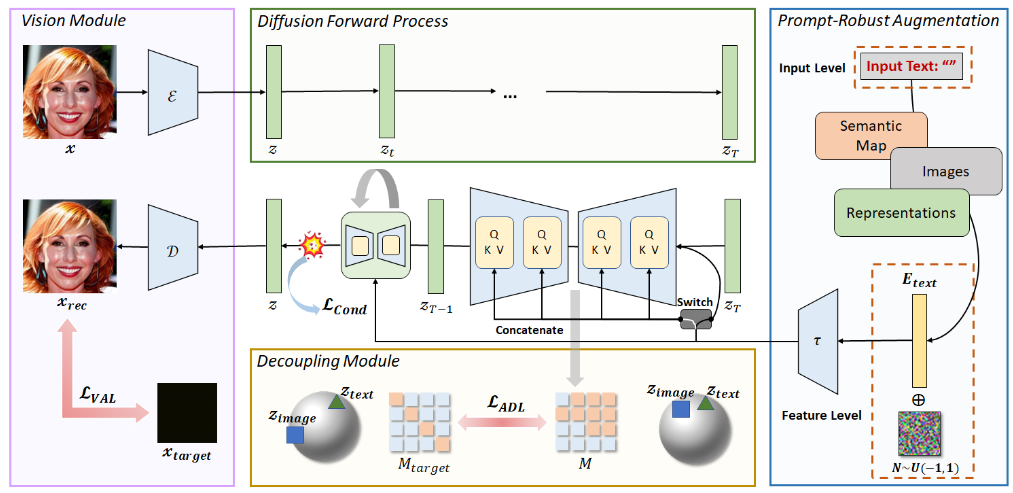
Vision-Adversarial Loss
\[L_{VAL} = \|x_{rec} - x_{target}\|_2\]The goal is to bring the reconstructed image closer to the target image, distancing it from training samples. → Aims to improve generation quality, reduce overfitting, enhance model robustness, and facilitate effective feature learning.
Prompt-Robust Augmentation (PRA)
text-to-image: “A cute cat sitting by the window.” Overfitting problem: “a cat playing in the garden” → fail
1. At the Text Input Level - Reducing Overfitting
- Use two special characters:
- Underscore:
"A cute cat_sitting by the window." - Empty:
"A cute cat, "
- Underscore:
2. At the Text Feature Level - Diversifying Text
- When generating adversarial perturbations, perform data augmentation on the text features.
- Ex. “A cat in a tree” → “A cat in a tree, possibly with a dog.”
Attention Decoupling Loss (ADL)
Focus on the attention matrix within the cross-attention mechanism to interfere with the image-text fusion process and prevent the network from establishing effective image-text mapping relationships.


Total Loss

Experiments
Paper #3: Glaze
Glaze: Protecting Artists from Style Mimicry by Text-to-Image Models
Shawn Shan, Jenna Cryan, Emily Wenger, Haitao Zheng, Rana Hanocka, Ben Y. Zhao 2023 USENIX Security, Published 2023/08
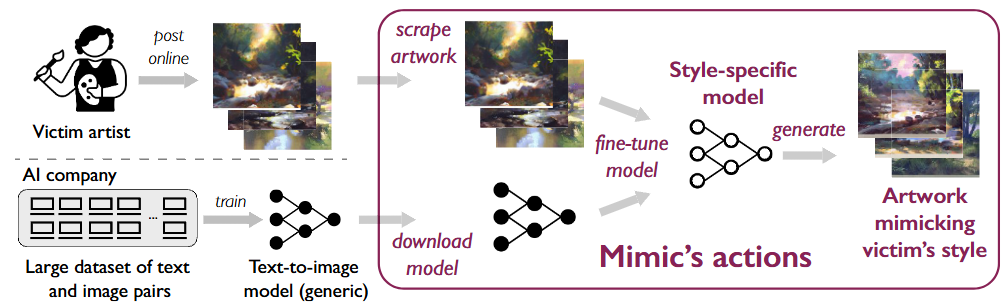
Disrupting Style Mimicry with Glaze
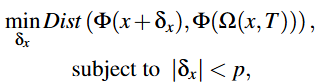
Transfer image(x) into target style T. By minimizing this distance, we can ensure that the generated artwork matches the target style in style.
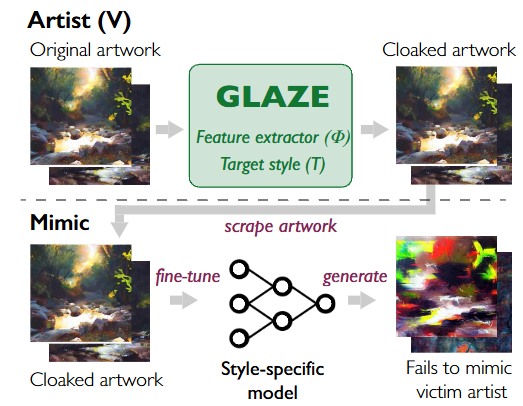

Detailed System Design
Step 1: Choose Target Style
- Select a target style (T) to disrupt mimicry.
- Use a public dataset to find different styles.
- Randomly choose a style that is 50-75% different from the artist’s original style.
Step 2: Style Transfer
- Use a style transfer model (Ω) to convert each artwork (x) into the target style (T).
- This creates a new version of the artwork, Ω(x, T).
Step 3: Compute Cloak Perturbation
- Calculate the perturbation (δx).
- Optimize δx using LPIPS to keep it visually similar to the original.
- Minimize the difference between the cloaked artwork and the style-transferred version.

- Brings the style-transferred image closer to the target style.
- Ensures that the generated image remains visually similar to the original artwork.
Evaluation
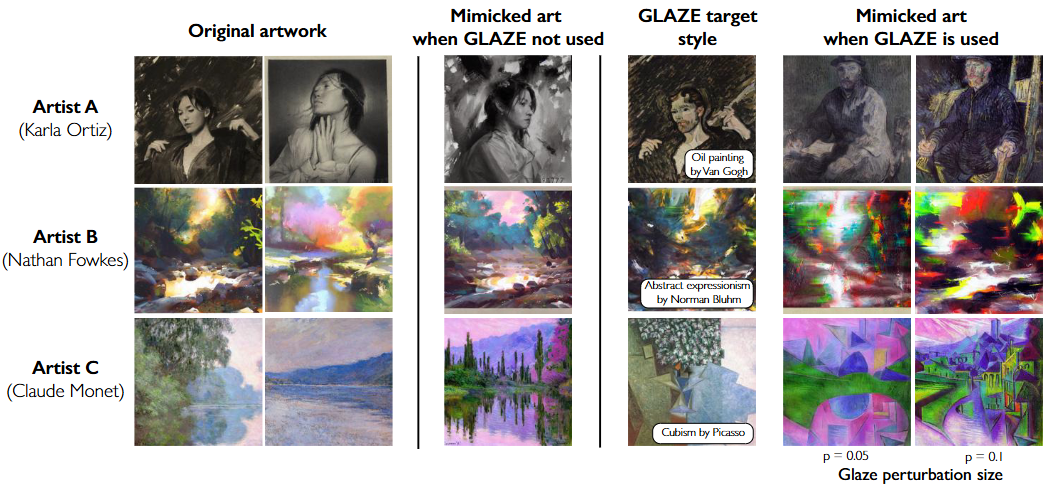
Glaze has a high protection success rate.
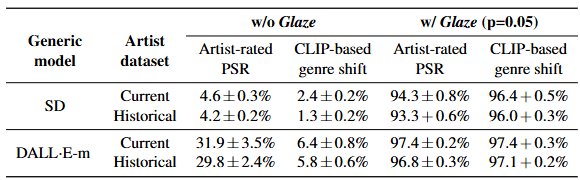
Results
Survey of Large Model Safety
Intellectual Property Protection
- Natural Data Protection: DUAW, AdvDM, Anti-Dreambooth, Numwan’s research…
- Generated Data Protection
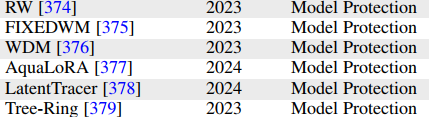
- Model Protection

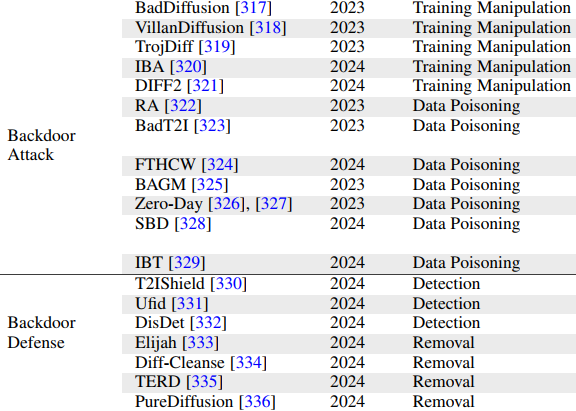
Backdoor Attack & Defense